Hello,
I wanted to know if turbogrid mesh in .cgns was compatible with TCAE?
When I try to import it, i get the error "The mesh has invalid format (sees picture).
Thanks in advance for any help.
Hello,
I wanted to know if turbogrid mesh in .cgns was compatible with TCAE?
When I try to import it, i get the error "The mesh has invalid format (sees picture).
Thanks in advance for any help.
Hello,
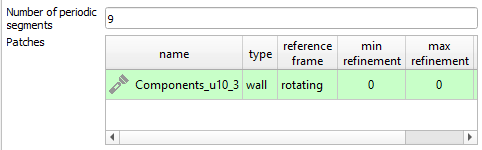
I wanted to know how to add patches to the component for which an external geometry has been imported.
Without that, I am unable to add inlet, outlet and other boundary conditions.
Hello all. There is a rectangular domain 20x40x12 m with a weak spring of the benzene vapour. The aim is to model the dispersion of benzene at the absolutely calm atmosphere (but with non-zero turbulence). I have tried a huge number of BC but failed with this task, because of the weak air currents that appear near the boundaries and at the corners. Their speed is about some centimeters per second but they are killing the process. Instead of descending to the ground (benzene has the density of 3,14), instead of penetrating through the boundary, instead of leaving the domain the benzene vapour goes up and curl and wirl ans so on. Please share your experience and help with a hint as of how to construct absolutely calm atmosphere. If it would be windy atmosphere or powerful spring of the vapour there would be no problems. Thanks.
The combination of fluid dynamics and machine learning has become an area of increasing interest in recent years, as researchers look for ways to use machine learning techniques to improve our understanding of fluid dynamics and make better predictions about fluid behavior.
One way that machine learning can be applied to fluid dynamics is through the use of data-driven models. These models are trained using large datasets of fluid flow data and can be used to make predictions about future fluid behavior. For example, a data-driven model could be used to predict the flow of air around an airplane wing or the movement of water in a river.
Another area where machine learning can be applied to fluid dynamics is in the optimization of fluid systems. By using machine learning algorithms to analyze fluid flow data, researchers can identify areas where fluid flow can be improved and develop optimized designs for fluid systems.
Overall, the combination of fluid dynamics and machine learning has the potential to revolutionize many scientific and engineering fields, providing new insights into fluid behavior and enabling the development of more efficient and effective fluid systems.
Dear Sirs,
I want to export a francis turbine runner geomtery to TCAE Pareview... I get always an error
"Loading inputfile "C:\Users\lenovo\Documents\resources\geometry\ft27022023.tcae"...
Required keyword "1_solid-meshInput" with 1 entries is missing in the setup file.
No path to STL file for solid component 1
Inputfile "C:\Users\lenovo\Documents\resources\geometry\ft27022023.tcae" contains invalid settings.
Failed to import surface geometry file "C:\Users\lenovo\Documents\resources\geometry\". A path to .stl or .step file expected."
Mesh is set to cfd mesh only...
anyone to help me..
Best Regards
Jamal
Hello everybody,
I try to model free convection inside vertical cylindrical container with elliptical bottom end. I cannot find how to calculate heat and mass fluxes (or flow rates) through horizontal plain, which divides elliptical and cylindrical parts. It is not a physical boundary, just a geometrical figure. For meshing I am using GMSH 4.8.4. Could someone help me please.
Hello everybody
At the moment I am doing a heat radiation simulation with the viweFactor model in OpenFOAM 8. It is about modeling the solar radiation on a mirror and reflecting it to a plate, I am not using the solid domains but I am modeling only the air domain. My problem is that I don't know which are the files or directories that I need to model the radiation with the viewFaxctor model?
Could you help me with an example, so I can develop my case study?
Thanks
CFDSUPPORT decided to publicly and freely share their OpenFOAM training materials.
The OpenFOAM training materials provided by CFDSUPPORT are an invaluable resource for anyone interested in learning OpenFOAM. With nearly 500 pages of comprehensive training material, the guide offers a step-by-step learning process that is tailored to suit the needs of both beginners and advanced users.
The guide covers a wide range of topics, including the basic principles of fluid dynamics, meshing, case setup, solver selection, post-processing, and more. The material is presented in a clear and concise manner, making it easy to understand even for those with little or no prior knowledge of CFD or OpenFOAM.
The training materials are accompanied by numerous examples and exercises that help reinforce the concepts covered in the guide. This hands-on approach is particularly useful in helping users develop the skills necessary to work with OpenFOAM effectively.
Moreover, the guide is available for free, making it accessible to anyone who is interested in learning OpenFOAM, regardless of their financial resources. This is a testament to the commitment of CFDSUPPORT to promoting education and innovation in the field of CFD.
Overall, the OpenFOAM training materials provided by CFDSUPPORT are a great resource for anyone looking to learn OpenFOAM, and I would highly recommend them to anyone who is interested in pursuing a career in CFD.
The download link is below in the comment section.
Please register to access it.
A forum category to discuss and exchange information, ideas, and knowledge related to the context of FEA and FSI. The goal of this category is to serve as a community of users, developers, and experts who interact and collaborate on various aspects of the software, such as usage, development, bug fixing, and feature requests. Joining this discussion group is a great way to learn from others and stay updated on the latest developments in open-source FEA and FSI. Specifically using Calculix but not exclusively.
A forum category to discuss and exchange information, ideas, and knowledge related to the context of ML/AI applied in engineering simulations.
The goal of this category is to serve as a community of users, developers, and experts who interact and collaborate on various aspects of the software, such as usage, development, bug fixing, and feature requests. Joining this discussion group is a great way to learn from others and stay updated on the latest developments in data analysis, and ML/AI in engineering simulations.
A forum category for hardware related to CAE (Computer-Aided Engineering) simulations for users, developers, and experts to discuss and exchange information, ideas, and knowledge about hardware components and systems that are suitable for CAE simulations.
The goal of this category is to bring a general discussion not specific to any single forum category, but instead, provide a general discussion space for a community.
A forum category to discuss and exchange information, ideas, and knowledge related to the context of open-source CAE (Computer-Aided Engineering) software.
The goal of this category is to serve as a community of users, developers, and experts who interact and collaborate on various aspects of the software, such as usage, development, bug fixing, and feature requests. Joining this discussion group is a great way to learn from others and stay updated on the latest developments in the field of open-source CAE software tools.
This category is focused on providing a public discussion, and guidance exclusively for the RWIND simulation environment. Specifically, the theory and strategies related to CFD methods.
RWIND is a software tool for simulating wind loads on buildings and other structures. It is a comprehensive tool that can be used to analyze the wind loads on a wide range of structures, including buildings, bridges, towers, and other structures. RWIND software also provides a user-friendly interface that allows users to easily input building geometry and wind data, as well as create and edit wind load cases. The results of the wind load calculations can be viewed and analyzed in various formats, including detailed reports, graphs, and 3D visualizations. It is used by engineers and designers to predict wind loads on a structure and check if it is designed to withstand those loads. It's a widely used tool by consultants and contractors for the design and construction of wind-sensitive structures like bridges, skyscrapers, towers, and more.
This category aims to enable discussion and support and enhance the users' knowledge and skills in using RWIND.
This category aims to enable discussion and support and enhance the users' knowledge and skills in using open-source CFD. Primarily OpenFOAM but not exclusively.