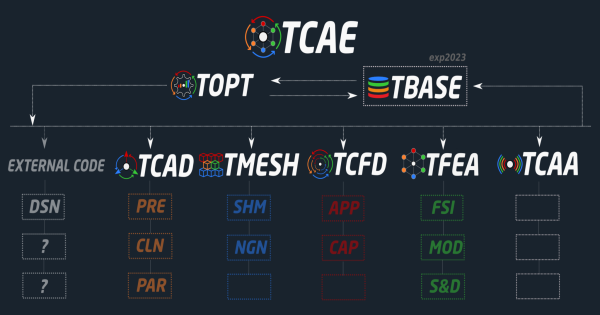
This category aims to enable discussion and support and enhance the users' knowledge and skills in using open-source CFD. Primarily OpenFOAM but not exclusively.
This category aims to enable discussion and support and enhance the users' knowledge and skills in using various software tools to create meshes for CFD and FEA simulations.
This category aims to enable discussion and support and enhance the users' knowledge and skills in using CAD tools to create simulation-ready models. The highest ambition is using fully automated geometry-builders for parametric optimization.
Computational Aeroacoustics (CAA) is a field of study that uses numerical methods to simulate and predict the generation, propagation, and effects of sound waves in a fluid flow. This category can include the analysis of noise generated by aircraft, wind turbines, and other machinery that operate in a fluid environment. The goal of this category CAA is to improve the understanding of the physical processes that lead to sound generation and to develop new technologies and design methods that can reduce noise emissions and improve overall performance. The discussion group is focused on the latest advancements, challenges, and future directions in the field of Computational Aeroacoustics.
This category is dedicated to Optimization in Engineering Simulations. We discuss here optimization methods, tools, and case studies.
CFD (Computational Fluid Dynamics), FEA (Finite Element Analysis), and FSI (Fluid-Structure Interaction) simulations are used to analyze and predict the behavior of fluid flow, heat transfer, and structural mechanics in various engineering applications. Optimization is the process of finding the best solution to a problem by adjusting various input parameters. Optimization can be applied to CFD, FEA, and FSI simulations to improve the accuracy and efficiency of the simulation results. For example, optimization algorithms can be used to adjust mesh size, boundary conditions, and material properties to improve the accuracy of the simulation results, or to minimize the computational cost of the simulation.
Parametric optimization is a specific type of optimization in which the input parameters of a CFD, FEA, or FSI simulation are varied systematically to find the optimal solution. In parametric optimization, a set of input parameters is defined as the design variables, and a set of performance criteria is defined as the objective function. The optimization algorithm then searches for the combination of input parameters that minimizes or maximizes the objective function.
For example, in a CFD simulation of fluid flow through a pipe, the design variables might include the pipe diameter and the roughness of the pipe walls, while the objective function might be the pressure drop across the pipe. The optimization algorithm would then search for the combination of pipe diameter and roughness that minimizes the pressure drop.
Similarly, in an FEA simulation of a structure, the design variables might include the material properties and dimensions of the structure, while the objective function might be the stress or deflection of the structure. The optimization algorithm would then search for the combination of material properties and dimensions that minimizes the stress or deflection.
In an FSI simulation, the design variables are the parameters that affect the fluid and structure behavior, the objective function can be the displacement of the structure or pressure of the fluid.
Parametric optimization can be a powerful tool for designing and optimizing engineering systems, as it allows engineers to quickly and efficiently explore the design space and find the best solutions to their problems.
This category is focused on providing public technical support and guidance exclusively for the TCAE simulation environment. The confidential technical support is provided via the ticket system accessible from Menu>Dashboard>Support.
The goal of this category is to provide technical support for TCAE users to share their knowledge and experience to help others troubleshoot technical issues, improve the performance of their simulations, and learn from one another. Members can ask questions, share their own solutions to common problems, and collaborate to improve the overall performance and efficiency of TCAE. The category is open to anyone who is interested in TCAE, regardless of their level of expertise.