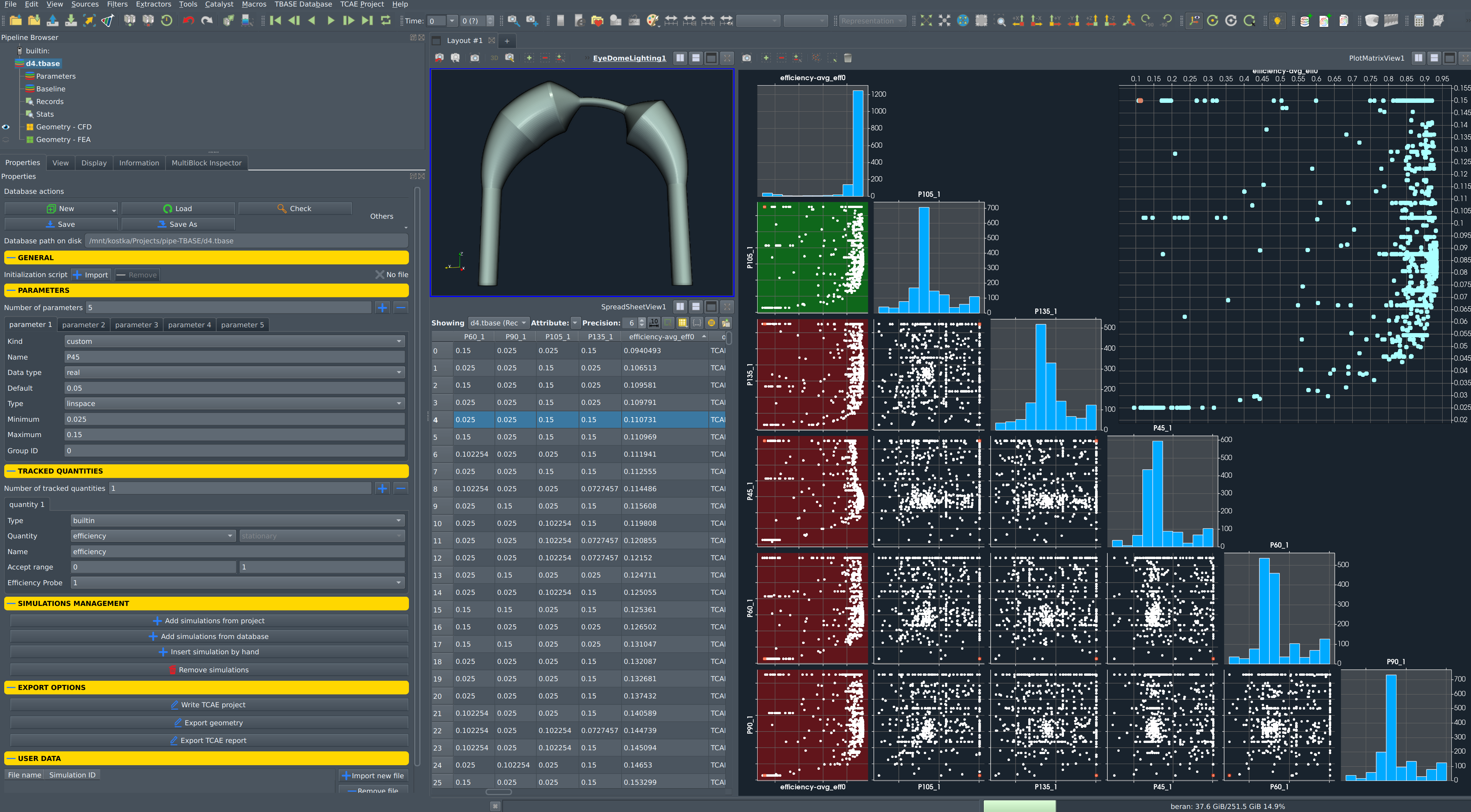
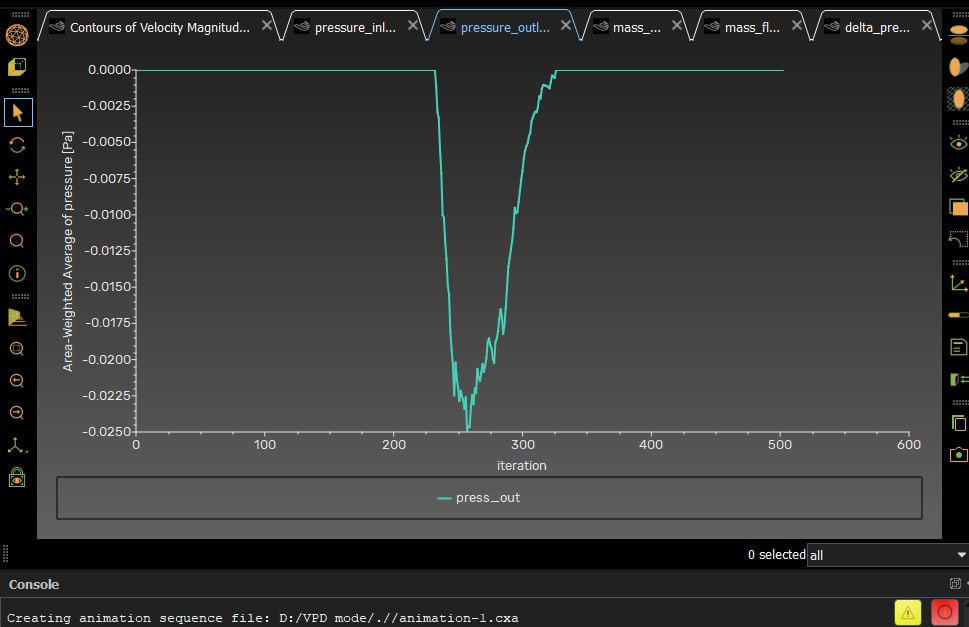
I am trying to simulate pelton distributor simulation tutorial in TCAE, but it is failing while i try to mesh all parts, is there any issue with tutorial file ?
Hi all,
No grid needed, predictions in seconds. Jiying 2.0-s is now live, predicting displacement, strain, and stress for 3D linear elastic problems. Visit jiying.io to try it online
From handwritten equations to modern supercomputers, we continue to explore how computation can help us understand the physical world.
What if every simulation could accumulate into knowledge, helping us understand the next entirely new design?
Today, Jiyng Technology's physics foundation model, JIYING 2.0-s, is officially launched. With a short film, we share our answer.
▼ Click to watch the launch video
[Insert launch video]
Physics simulation allows us to validate designs before manufacturing. Yet within vast amounts of simulation data lies physical laws that can be learned and transferred.
The core of JIYING 2.0-s is generalization.
Enable the model to learn from existing physical data, apply the learned laws to new engineering problems, and make past computations the foundation for the next prediction.
New geometry. New loads. New materials.
One model.
No mesh required. Second-level prediction.
We hope to enable engineers to validate an idea faster and explore more design possibilities with greater ease.
From geometry, to physics.
Let machines understand physics.
Visit jiying.tech to learn about JIYING 2.0-s.
https://www.youtube.com/watch?v=glypJMj757g
Hi everyone,
Lubos suggested by email that I post my request here.
I’m currently working on RANS turbulence modeling, and I’d like to use the Ahmed Body case from CFD SUPPORT as one of my validation cases.
I found the Ahmed Body benchmark page and the old OpenFOAM tutorial page, but I couldn’t find a working download link for the case anymore.
I’m mainly looking for the OpenFOAM case or mesh files, especially the snappyHexMesh setup and the mesh used in the benchmark. I saw that the old file was called:
AhmedBody-tutorial-OpenFOAM-17.10.zip
and there also seems to be a newer TCAE version of the Ahmed Body case.
If anyone has a current download link, or if there is a newer version that replaces the old OpenFOAM case, I’d really appreciate it if you could share it.
The case will only be used for academic research and RANS model validation.
Thanks a lot!
Best,
Herry
I have released an early Windows CAE utility called CrashLens Reporter.
It batch-processes exported LS-DYNA result folders and generates structured PDF and Excel reports for comparing simulation runs.
The current version supports exported ASCII, CSV, and XY-style result files. It does not directly read binary d3plot or binout files yet.
I would appreciate feedback from CAE/FEA users on which outputs and metrics should be prioritised next.
Examples:
- GLSTAT
- MATSUM
- RCFORC
- SPCFORC
- NODOUT
- SECFORC
Product/demo pages:
https://payhip.com/b/1BkPG
https://payhip.com/b/M9QVz
CrashLens Reporter is independent and is not affiliated with or endorsed by Ansys.
Hi,
I’m looking for technical criticism on an early architecture/RFC-stage open-source CAE application-layer initiative.
The goal is not to build a new solver, clone commercial CAE software, or replace existing open-source tools.
The goal is to define the missing application layer that could connect existing open-source engineering tools into one coherent workflow: CAD/geometry, assemblies, MBD, FEA, CFD-ready workflows, meshing, visualization, results, reporting, and future automation.
The public repository is currently focused on architecture, RFCs, MVP definition, and technical review. There is no public implementation yet, although the architecture is informed by prior private prototype work around a Qt-based desktop CAE shell, model tree workflows, viewport interaction, command routing, and diagnostics.
I’m especially interested in feedback from CAE users on:
1. Whether the application-layer direction makes sense.
2. What risks exist around connecting CAD, meshing, solvers, and results into one workflow.
3. How FEA/CFD boundary regions, mesh groups, loads, and result fields should influence the early architecture.
4. Whether the proposed Core Model / Solver Adapter / Results Layer separation is reasonable.
5. What mistakes should be avoided before implementation begins.
Repository:
https://github.com/Shlomo365/open-cae-application-layer
Main RFC discussion:
https://github.com/Shlomo365/open-cae-application-layer/discussions
The most useful feedback would be:
What is the biggest architectural risk, missing assumption, or workflow mistake in this direction?
Thanks,
Shlomo
Hi everyone
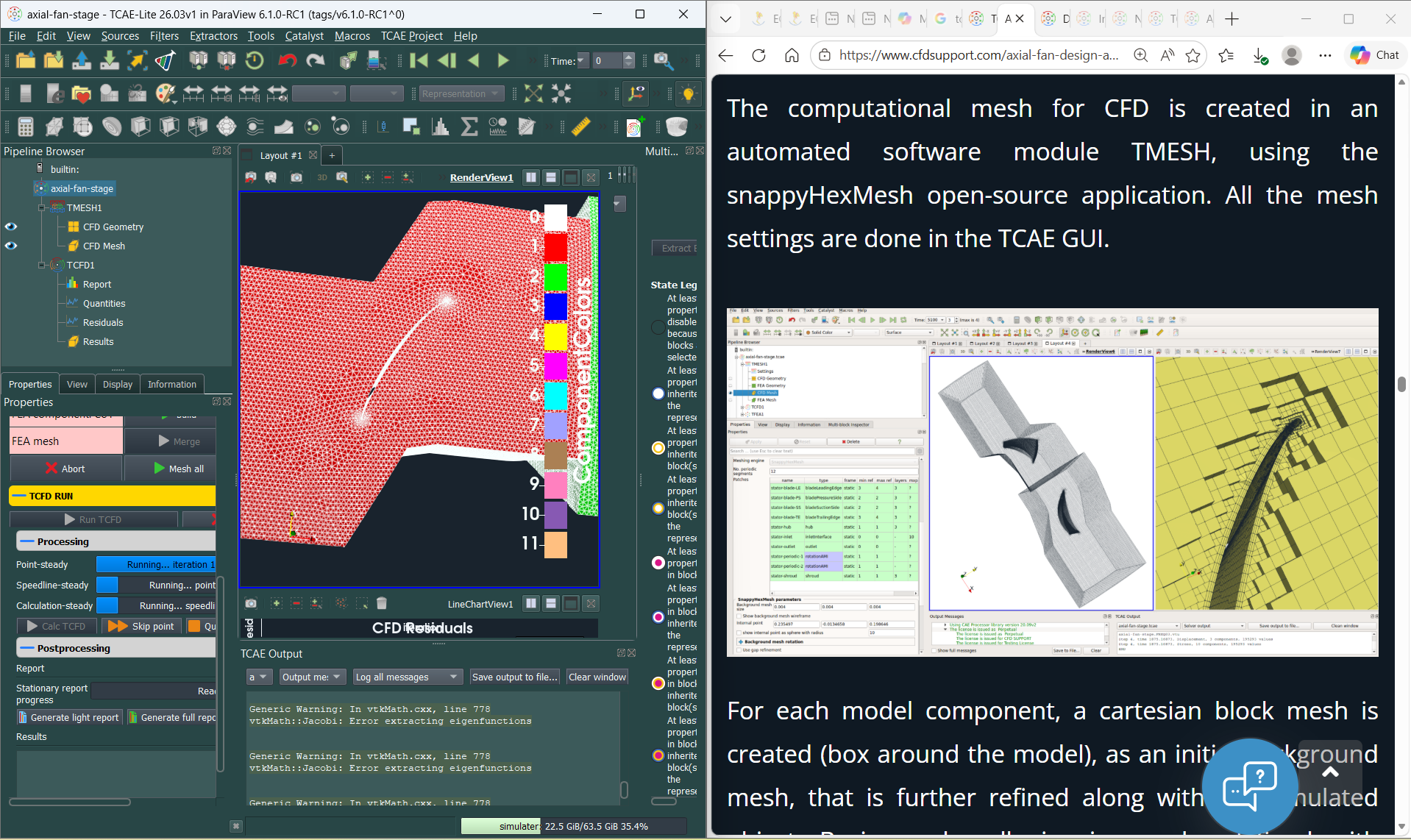
I started setting up Hexahedral mesh in TCAS-lite with Axial design and simulation (Axial Fan Design and Simulation – CFD SUPPORT).
After finishing mesh generation, please see in attached picture, I found mesh created shown as Tetrahedral mesh (left side) but in tutorial report be Hexahedral mesh.
I am new user for TCAE. I'm thing there something wrong during my first setup.
Is there any suggestion for make Hexahedral mesh?
I need to simulate a hydrogen explosion near a wall: I need pressure values over time for the structural calculation.
Is it possible to set up the simulation and use BlastFoam in TCFD?
Reading around, I found that the XiFoam or XiFluid solvers exist: does anyone know anything about them? Could they be integrated into TCFD?
Dear CFD Support team,
I am a Master’s student in Mechanical Engineering (Energy Transition specialization) at the University of Brescia, Italy.
For one of my CFD/OpenFOAM exams, I am required to develop a validated simulation project (not a thesis, but an academic project), including comparison with reference or published results. For this purpose, I downloaded your Burj Al Arab simulation example from your platform.
My goal is to reconstruct the case in OpenFOAM and use it as part of my exam project. I would like to kindly ask if it would be possible to receive additional technical details to help me accurately reproduce the simulation in OpenFOAM. In particular, I am looking for:
Computational domain dimensions and setup;
Boundary conditions (inlet velocity profile, outlet, wall and ground conditions);
Turbulence model and main parameters;
Mesh generation details (refinement regions, layers, resolution);
Reference values used for force coefficients or validation
If available, even a simplified description of the setup or equivalent OpenFOAM dictionaries (0/, constant/, system/) would be extremely helpful.
The purpose of my work is purely academic, and I aim to ensure the simulation is physically consistent and properly validated.
Thank you very much for your time and support.
Best regards,
Hamza Chokry
I need to simulate this in fluent.
Take a bubble of radius 1 mm with internal pressure as 3 kPa, while the outside liquid is at 1 bar pressure. This bubble is at a distance of 1.1 mm from a flat surface. Gravity acts vertically down.
the bubble is of vapour.
I used multiphase model with VOF.
I created a Rectangular domain to simulate it in 2D with suitable dimensions.
I am facing problems in setting up the pressure difference in and outside the bubble , like I used operation condition has 100kPa , and boundary conditions as pressure oulet for top, right and left side of the Rectangular domain , and wall for bottom side.
Then I patched the bubble with suitable radius, but I am not able to set the presure differnce .
Could anyone help me setting the pressure difference.
Artificial intelligence is changing our world as we know it. A storm of change concerns every field, everything, and everyone. In this little thought experiment, I would like to think about how our beloved Computational Fluid Dynamics (CFD) and CAE simulations are likely to change. I know, I know. Predicting the future is generally a foolish exercise, …, so I decided to write the following lines about it. Disclaimer: It’s March 2026.
At the moment, AI is entering CFD through at least three distinct paths, each affecting engineering work in a very different way: Agents, Surrogates, and Coding. These three guys are already happening, and they are quickly changing CAE, and the pace is only growing. Let’s take a look at them one by one.
I need to learn how to model fire and explosion with cfd. Can any one help me?